Okay, as a professional content creator, I will craft a complete article based on the reference content and requirements you provided.
In-Depth Interpretation of Xiaomi Group's Capital Operation Strategy: Dual Signals of Share Issuance and Buyback
Keywords: Xiaomi Group, Share Issuance, Share Buyback, Financial Strategy, Market Signal, Equity Incentive, Shareholder Value
Introduction
In the capital market, a listed company's share change announcements are often not just simple data disclosures, but a window into the company's strategic intent, financial health, and confidence in the future. Recently, a next-day disclosure report by Xiaomi Group (hereafter referred to as 'Xiaomi') detailed its share issuance and buyback activities over a specific period. On the surface, this is a routine information disclosure, but when we look beyond the data and delve into the logic behind these operations, we can see Xiaomi's maturity and foresight in capital operations. This article aims to combine this announcement content to conduct an in-depth analysis of Xiaomi's recent capital operations from three dimensions: share issuance, share buyback, and overall strategy.
I. Share Issuance: Strengthening Talent Foundation, Driving Long-Term Growth
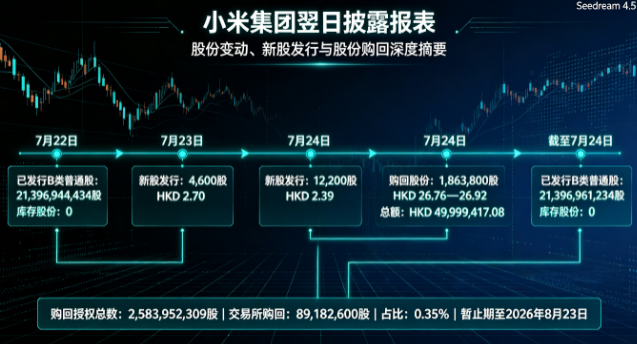
The announcement shows that from July 23 to 24, 2026, under the share plan, Xiaomi issued 4,600 and 12,200 new shares to participants (excluding directors), with issue prices of HKD 2.7 and HKD 2.39 per share respectively. Although the total number of shares issued in these two rounds (16,800 shares) is negligible compared to Xiaomi's massive issued share capital (approximately 21.397 billion shares, accounting for about 0.0008%), their strategic significance cannot be underestimated.
First, this clearly demonstrates Xiaomi's long-term commitment to employee equity incentives. Share awards and options are key tools for high-tech companies to attract, retain, and motivate core talent. By deeply binding employees' personal interests to the company's long-term value growth, Xiaomi can effectively stimulate team innovation vitality and sense of belonging. This is particularly crucial in frontier fields like AI and smart cars, where talent stability directly determines the company's technical moat. Second, the extremely low issue price (relative to market price) also reflects that these stock awards are part of the compensation package, recognizing and motivating past or future contributions.
It can be said that this 'targeted, small-scale, low-cost' new share issuance is a concrete manifestation of Xiaomi's 'talent-first' strategy at the capital level. It does not cause significant dilution to existing shareholders' equity but injects key human capital momentum into the company's long-term development.
II. Share Buyback: Conveying Market Confidence, Optimizing Capital Structure
In stark contrast to share issuance, Xiaomi also conducted large-scale share repurchases during the same period, forming another core highlight of this announcement. The announcement shows that from early June to July 24, Xiaomi continuously executed its share buyback plan. On July 24 alone, the company repurchased 1,863,800 of its own shares at prices between HKD 26.76 and HKD 26.92 per share, totaling nearly HKD 50 million.
Share buyback is an important way for listed companies to reward shareholders, increase earnings per share, and convey confidence to the market. Given the current global macroeconomic uncertainties and valuation pressure on tech stocks, Xiaomi's persistent buyback releases a strong positive signal: management believes the current stock price does not fully reflect intrinsic value, and they are expressing confidence in the company's future business development and profitability through concrete actions. Additionally, although the repurchased shares are not yet canceled, this move directly reduces the market's supply of floating shares, helping to stabilize or even boost the stock price when demand remains unchanged or increases, which has a positive impact on protecting minority shareholders' interests.
Notably, the buyback authorization resolution was passed on June 2, 2026, authorizing a total repurchase of up to approximately 2.584 billion shares. As of July 24, Xiaomi had actually repurchased only 89.18 million shares under this authorization, accounting for about 0.35% of the authorized buyback total and 0.35% of the shares issued on the resolution date. This means Xiaomi still has ample buyback ammunition to conduct more aggressive market value management based on market conditions and its own judgment.
III. Strategic Significance of Capital Operation Strategy
Combining share issuance and buyback, Xiaomi is executing a refined capital operation strategy of 'one release, one repurchase'.
- 'Release' for Talent: Through limited, low-cost equity incentives, precisely invest in core human capital that creates future company value.
- 'Repurchase' for Shares: When the stock price is low, use the company's ample cash flow or borrowing capacity to systematically buy back undervalued shares, optimizing per-share value.
The brilliance of this strategy lies in balancing short-term market performance and long-term value creation. On one hand, buyback effectively offsets the slight dilution caused by equity incentives and can even increase earnings per share; on the other hand, stable incentive expectations ensure the company has a continuous source of innovation momentum.
Additionally, the 'suspended period' mentioned in the announcement is noteworthy. After the share buyback, the company must not conduct any new share issuance or treasury stock sale until August 23, 2026. This shows that Xiaomi strictly adheres to market rules and treats the buyback as an independent, closed-loop operation, avoiding market misunderstanding of the complex 'buying and selling at the same time,' reflecting its standardized and transparent corporate governance.
Conclusion
In summary, Xiaomi Group's recent share change announcement is far from a boring list of numbers. It vividly paints a picture of a mature tech company's capital operations in a complex market environment. Through the combined approach of 'equity incentives to stabilize talent base' and 'share buybacks to solidify market confidence,' Xiaomi demonstrates its financial management flexibility, attention to shareholder interests, and firm belief in its long-term value. For investors, understanding the logic behind these capital moves may be more valuable than focusing on short-term stock price fluctuations. In fierce industry competition, this financial strategy that balances internal and external factors and short-term and long-term goals is undoubtedly an important support for Xiaomi's steady and sustainable development.