
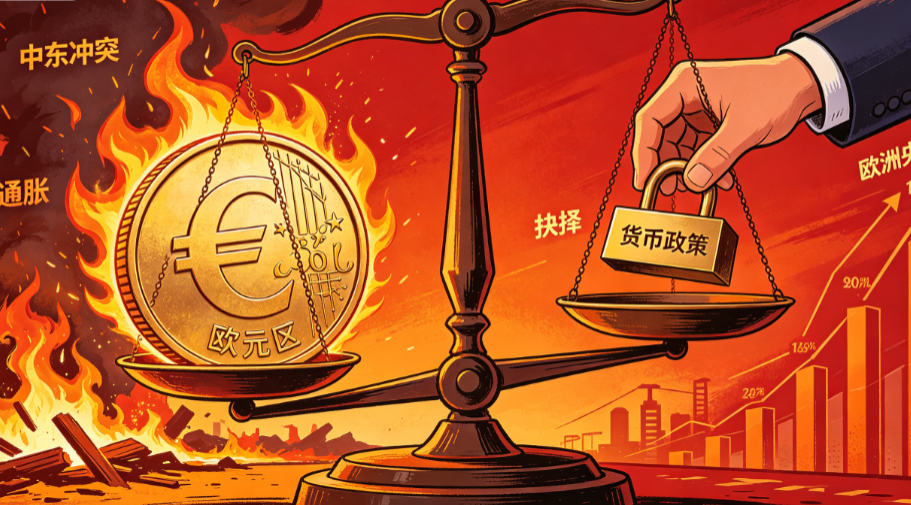
Eurozone under the shadow of Middle East conflict: inflation pressure and monetary policy choices
Keywords: Middle East conflict; energy prices; Eurozone inflation; ECB rate hike; German economy
Introduction
Since 2023, the continued tension in Middle East geopolitics has cast a heavy shadow over the global economy. The eruption of the new Israeli-Palestinian conflict and its spillover effects, especially the spread of the Red Sea shipping crisis, directly impacted the global energy supply chain. For the Eurozone, which is heavily dependent on energy imports, this impact is like pouring salt on a wound that has not yet healed—energy prices, which had slowly recovered from the Russia-Ukraine conflict, are rising again, and inflation pressure is not only persisting but spreading. Facing this complex situation, the ECB announced a 25-basis-point rate hike at its latest meeting and released a strong signal that it may raise rates again in July if inflation does not ease significantly. At the same time, Germany, the Eurozone's economic engine, released a worrying forecast: the Bundesbank expects German GDP growth of only 0.5% in 2026, with inflation still high at 2.9%. This series of data and policy moves reflects the profound dilemma the Eurozone is experiencing—how to find a balance among energy shocks, sticky inflation, and weak economic growth has become a severe test for the ECB and the entire Eurozone.
I. Energy price transmission: mechanism analysis from geopolitical shock to inflation spread
The Middle East, as the core region of global energy supply, has multiple transmission paths for its turbulence to affect the Eurozone. First, the direct surge in oil prices is the most obvious channel. Brent crude briefly broke above $90 per barrel during the escalation of the Middle East conflict, and although it has since retreated, volatility has increased significantly. For the Eurozone, higher oil import costs directly push up costs in transportation, chemicals, and other industries, gradually transmitting to final consumer goods prices through the production chain. More tricky is that the Red Sea shipping crisis has blocked the Suez Canal route, forcing ships to detour around the Cape of Good Hope, significantly increasing shipping time and costs. This "logistics bottleneck" not only raises the landed price of energy products but also disrupts the supply rhythm of manufacturing components, creating dual pressure from supply-side shocks and cost push.
Notably, this inflation spread has different characteristics from previous ones. Unlike 2021-2022 when the energy shock was mainly driven by post-pandemic demand recovery and the Russia-Ukraine conflict, the current inflation pressure is more deeply rooted in structural factors. On one hand, insufficient investment in traditional energy capacity during the Eurozone's energy transition has reduced supply elasticity; on the other hand, the duration and evolution path of the Middle East conflict are highly uncertain, making it difficult for companies to formulate long-term pricing strategies, and they pass rising costs on to consumers. This "cost-push" inflation, once inertial, easily evolves into a "wage-price spiral," eroding the effectiveness of the ECB's previous rate hikes.
From the data perspective, the decline in the Eurozone's core inflation (excluding energy and food) is significantly slower than the headline inflation rate, indicating that price pressures have spread from the energy sector to broader economic sectors such as services and non-durable goods. For example, service sector inflation in Germany, France, and other countries remains above 4%, reflecting continued increases in rigid expenditures like rent, healthcare, and education. This spreading inflation pattern means the ECB cannot rely solely on supply-side improvements to ease pressure but must continue to curb price increases through demand-side regulation.
II. ECB's dilemma: balancing rate hikes to fight inflation and stabilizing growth
The ECB announced a 25-basis-point hike in its three key rates at its latest meeting, the ninth consecutive rate hike since starting the cycle in July 2022. This move shows that despite the Eurozone's economic growth already slowing and even bordering on recession, the central bank's decision-makers still prioritize controlling inflation. President Lagarde clearly stated in the post-meeting statement that Eurozone inflation is still too high and is expected to remain above the target level for a longer period, so "the possibility of continuing to raise rates in July cannot be ruled out." This hawkish tone exceeded market expectations, reflecting the ECB's deep concern about inflation stickiness.
However, continued rate hikes inevitably exacerbate negative impacts on the economic fundamentals. The Eurozone manufacturing PMI has been in contraction for several consecutive months, German manufacturing orders have fallen sharply, and business investment sentiment is low. Rate hikes further raise financing costs, directly hitting rate-sensitive sectors like real estate and SMEs. Meanwhile, tightening credit conditions also curb consumer spending, with private consumption, a key engine of the Eurozone economy, showing signs of weakness. The ECB's actions essentially make a difficult choice under the shadow of "stagflation"—if too tight, the economy could fall into deep recession; if premature easing, inflation could reignite, wasting previous efforts.
From a policy communication perspective, the ECB intends to manage market expectations through "forward guidance." The hint of a July rate hike aims to prevent inflation expectations from becoming unanchored while retaining flexibility for subsequent decisions. But the risk of this strategy is that if economic data continues to deteriorate, the market may question the central bank's ability to respond to economic conditions, weakening monetary policy transmission efficiency. Additionally, there are clear internal divisions within the ECB: hawks represented by Bundesbank President Nagel advocate decisive action to curb inflation, while some officials from southern European countries are more concerned about the impact of rate hikes on growth and employment. This internal split may undermine the authority of the central bank's decisions.
III. German case: economic engine stalling and long-term inflation troubles
As the largest economy in the Eurozone, Germany's economic direction is a bellwether for the region. The latest economic forecast from the Bundesbank adds fuel to pessimistic expectations: it expects German GDP growth of only 0.5% in 2026, with inflation still at 2.9%. This means that even three years later, Germany's inflation will find it difficult to return to the ECB's 2% target, while economic growth is almost stagnant—effectively a picture of "chronic stagflation."
Germany's economic woes result from multiple factors. First, its economic structure heavily reliant on manufacturing and exports makes it exceptionally sensitive to external shocks. The surge in energy prices after the Russia-Ukraine conflict hit Germany's pillar industries like chemicals and automobiles hard, forcing many companies to reduce production or relocate production capacity. The further impact of the Middle East conflict has made hopes of energy costs returning to pre-conflict levels slim. Second, Germany faces severe labor shortages and an aging population, constraining potential output growth. The rising benchmark rate has also exacerbated the real estate market adjustment, with building investment falling sharply. Additionally, Germany's fiscal policy is constrained by the "debt brake" mechanism, preventing large-scale stimulus as during the pandemic.
Notably, the 2.9% inflation rate in the Bundesbank's forecast, though lower than the current level, is still far above the 2% comfort zone. This means the "last mile" of inflation will be particularly difficult. Since service sector inflation is stickier and wage increase pressures (such as the 8.5% raise negotiated by the metal industry union) are transmitting to costs, Germany may experience the pain of "low growth, high prices" for several years. This pattern could exacerbate the north-south divide within the Eurozone, creating greater constraints for the ECB in formulating unified monetary policy.
IV. Future outlook: policy paths and economic resilience under geopolitical risk
Looking ahead, the trajectory of the Eurozone economy will largely depend on the evolution of Middle East geopolitics. If the conflict can cool down and energy supply chains return to normal, the pace of inflation decline will accelerate significantly, and the ECB may begin discussing rate cuts by the end of 2024. However, if the conflict continues or even escalates (e.g., Iran intervention or closure of the Strait of Hormuz), energy prices could surge again, plunging the Eurozone into a more severe inflation spiral and forcing the ECB to hike rates further, increasing the risk of a hard landing.
From a policy response perspective, the ECB needs to work on several dimensions simultaneously: first, strengthen early warning and response mechanisms for external shocks, improving policy flexibility through scenario analysis; second, enhance coordination with fiscal policy to avoid overly suppressing domestic demand while controlling inflation; third, promote diversification of the Eurozone's energy structure and accelerate renewable energy investment to fundamentally reduce dependence on imported fossil fuels. Countries like Germany also need to accelerate structural reforms, including easing labor market regulations, promoting digital innovation, and improving the business environment, to boost long-term potential growth rates.
The current situation facing the ECB has similarities to the 1970s "oil crisis," but with higher globalization and richer policy tools. Historical experience shows that timely and determined tightening, though causing short-term pain, is the only reliable path to curing sticky inflation. However, this process requires public patience and cooperation, and government targeted subsidies to protect the most vulnerable groups. Only then can the Eurozone find a narrow path to price stability and sustainable growth amid the haze of the Middle East conflict.
Conclusion
The energy price shock triggered by the Middle East conflict has spread inflation pressure from the energy sector to all corners of the Eurozone economy. The ECB had to continue raising rates against the backdrop of slowing economic growth and hinted at possible further action in July. Germany, as the regional economic pillar, with its 2026 GDP growth forecast of only 0.5% and inflation still at 2.9%, profoundly reveals the long-term dilemma of "low growth, high inflation" facing the Eurozone. In this protracted war against inflation, the ECB needs to balance the suppression of domestic demand and the management of expectations, coordinate the pace of monetary policy and structural reforms, and directly face the challenge of geopolitical uncertainty. When energy games become the new normal, the Eurozone's way out lies not only in the precise use of interest rate tools but also in promoting economic structural transformation and energy independence. The road ahead is difficult, but the direction cannot waver: only by firmly bringing inflation back to the target range can the foundation for healthy development of the Eurozone economy be laid.

