
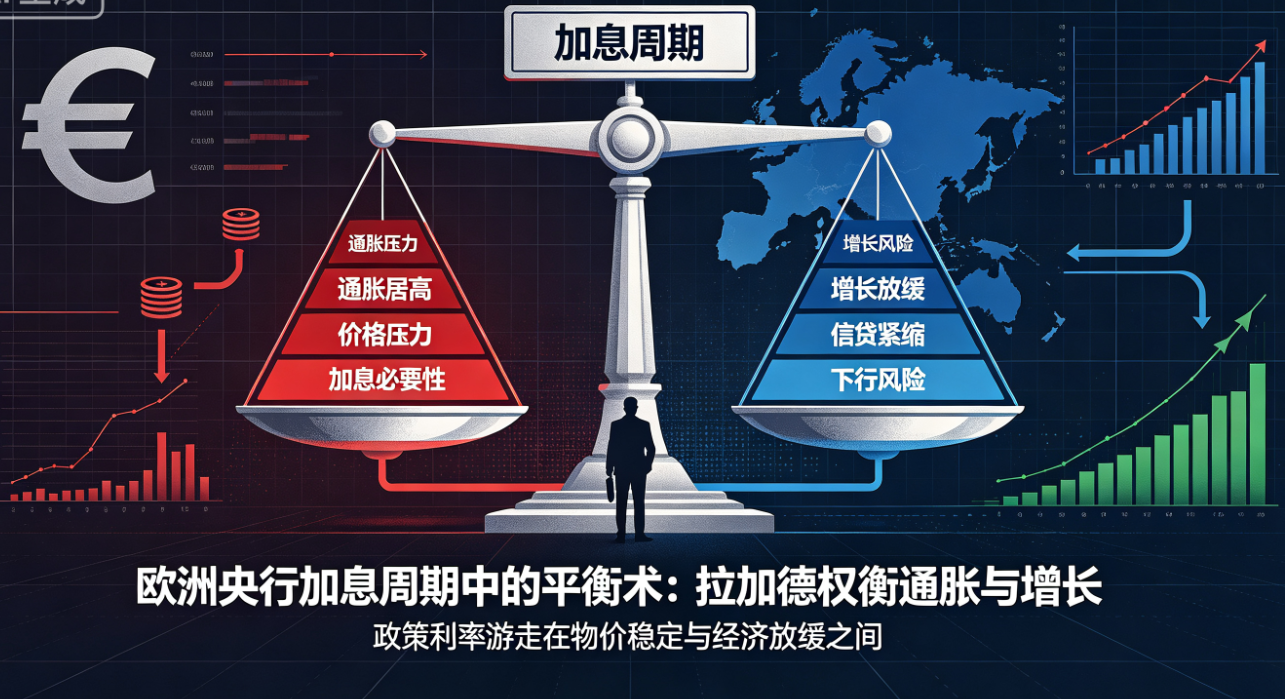
The Balancing Act on the Decision Scale — Trade-offs and Forward Look in the ECB's Rate Hike Cycle
Keywords: ECB; Lagarde; Rate Hike; Inflation; Oil Price; Monetary Policy
Introduction
As major global central banks enter the tail end of their tightening cycles, ECB President Lagarde recently released a subtle yet crucial signal: the June rate hike has been confirmed as the 'correct decision', but the July meeting may stand pat, with future policy direction depending on the pass-through of oil price fluctuations. This statement is both a technical response to the recent balance between inflation and growth risks and an active guidance of market expectations. It reveals the complex situation of the ECB seeking balance between fighting inflation and stabilizing growth, and suggests that eurozone monetary policy is evolving from aggressive to fine-tuned. Based on an analysis of Lagarde's key points, combined with the eurozone economic status and oil price transmission mechanisms, this article delves into the inner logic of this policy path and its potential global implications.
I. The 'Correct Decision' of the June Rate Hike: Dual Support from Data and Logic
Lagarde explicitly called the June rate hike a 'correct decision', a judgment based not on political rhetoric but on facts from eurozone economic data and inflation expectation developments. From the inflation side, although headline inflation has fallen from a peak of over 10% last year to around 6%, core inflation (excluding energy and food) remains stubbornly above 5%, and services inflation continues to rise. This indicates that inflation pressure has shifted from supply-side shocks to demand-driven and wage-price spirals, and the transmission effect of monetary policy takes time to fully manifest.
From the growth side, eurozone Q1 GDP grew only 0.1% quarter-on-quarter, essentially stagnating. Germany's economic contraction, manufacturing PMI below the boom-bust line for months, and declining business confidence indices together paint a picture of weak growth momentum. Yet Lagarde did not use this to deny the need for a rate hike; on the contrary, she emphasized that the June hike was 'correct' because inflation expectations have not yet fully anchored, and prematurely stopping tightening could undo previous progress.
Historically, since the ECB started hiking in July 2022, it has cumulatively raised rates by 400 basis points, the most aggressive tightening cycle in its history. Raising the deposit rate further to 3.50% in June was not only a commitment to price stability but also a reaffirmation of market discipline. Lagarde's statement makes this clear: even if growth slows, monetary policy cannot easily change course because the tail of inflation may be longer than expected.
II. Risk Balance Tipping: The Game Between Upside Inflation and Downside Growth
The most informative part of Lagarde's speech was her point that 'upside risks to inflation and downside risks to growth are now becoming balanced'. This assessment marks a fundamental shift in the ECB's understanding of the macroeconomic situation. Previously, the ECB emphasized that upside risks to inflation were dominant, requiring continued hikes; now, downside growth risks are rising at an equal or faster pace, forcing policymakers to reassess the threshold of the policy mix.
Upside risks to inflation come mainly from several aspects: first, the lagged effect of rising wage costs—the eurozone unemployment rate is at a historic low of 6.4%, and tight labor markets are pushing nominal wage growth to around 4.5%, driving services prices higher; second, corporate margins have not yet fully contracted, with some companies using the inflation environment to raise prices, creating a 'profit-inflation' loop; third, geopolitical factors, especially energy supply uncertainty from the Middle East.
Downside risks to growth are more pressing: credit tightening has emerged—bank lending to businesses has slumped from 6% at end-2022 to about 1.5% in May, and household loans are almost stagnant. High rates are dampening investment and consumption, and manufacturing exports face pressure from weak global demand. Additionally, the US debt ceiling debate and China's recovery pace below expectations add external uncertainty.
The balance between the two means that the traditional Taylor rule's 'output gap' and 'inflation gap' are offsetting each other. The ECB can no longer simply decide based on inflation readings but must introduce a more complex discretionary mechanism. This explains why Lagarde emphasized 'possible inaction in July'—waiting for more data is the most rational choice until the risk balance clearly tips.
III. Logic of Inaction in July: Observation Window and Expectation Management
Lagarde's clear statement that 'the July meeting may stand pat' is seen as a turning point from a 'hawkish stance' to 'data dependence'. Why choose to pause in July rather than immediately or later? The logic is as follows:
First, after the June hike, the policy rate is close to or above the estimated neutral rate interval (around 2.0%-2.5%). The marginal benefit of further hikes is diminishing while the marginal cost is rising. A pause allows the effects of previous tightening to be fully released, avoiding excessive damage to the economy.
Second, July is the last meeting before the traditional summer break, with an interval of nearly two months. During this time, the ECB can collect more data on inflation, wages, credit, and a clear signal on oil price trends. By making subsequent action depend on 'the pass-through of oil price volatility', Lagarde essentially uses energy market dynamics as a core decision variable. Due to the profound changes in Europe's energy structure after the Russia-Ukraine war, the time lag and elasticity of oil price transmission to overall inflation via chemicals, transport, and electricity have changed, requiring longer observation.
Third, pausing is also an expectation management tool. If the market prices in a July hike prematurely, it could exacerbate financial tightening and compress policy space. By proactively signaling a pause, Lagarde can stabilize market expectations, reduce excessive volatility in long-term rates, and provide a clearer financing environment for businesses and households.
Of course, a pause does not mean a policy pivot. Lagarde emphasized that 'subsequent action depends on oil prices', meaning that if oil prices spike due to supply shocks, the ECB could still resume hiking in September or later. Conversely, if oil prices continue to fall, this rate hike cycle may end.
IV. Oil Prices — The Damocles Sword Hanging Over Policy
It is no coincidence that Lagarde listed oil price fluctuation pass-through as a decisive factor for subsequent policy decisions. The eurozone is heavily dependent on energy imports, and global oil prices are affected by multiple factors such as OPEC+ production cuts, geopolitical conflicts, and the dollar's trend, making them highly unpredictable. Currently, Brent crude oscillates in the $75-80/barrel range, but if Middle East tensions lead to disruption through the Strait of Hormuz, oil prices could quickly break $100, pushing up eurozone CPI by about 0.5-1 percentage points through imported inflation.
What deserves more attention is the change in transmission mechanisms. Unlike 2022, European companies have partly absorbed high oil prices and locked in some costs through long-term contracts. However, the indirect effects of oil price volatility on core inflation—such as through transport costs pushing up food prices and through chemicals pushing up industrial prices—continue. Additionally, consumer inflation expectations remain highly sensitive to oil prices, which could lead to persistence effects in wage negotiations.
The ECB's response strategy has two dimensions: short-term, track the actual movement of oil prices; if prices overshoot unexpectedly, trigger a longer rate hike cycle; medium-term, focus on the stability of inflation expectations to prevent oil price shocks from turning into broad price increases. By explicitly stating that 'subsequent action depends on oil prices', Lagarde essentially delegates some decision power to energy markets, which presents both risks and opportunities for market participants.
Globally, oil price uncertainty also affects the policy synchronization of other central banks. The Fed and BOE face similar dilemmas, but the ECB is more fragile because the eurozone is less economically integrated, national fiscal spaces vary widely, and a single monetary policy has limited effectiveness in responding to asymmetric shocks.
V. Forward Look: A Flexible Path Under Data Dependence
Looking ahead, the ECB's monetary policy path has shifted from linear rate hikes to a 'flexible range'. Against a backdrop of declining inflation but weak growth, Lagarde and her colleagues will rely more on a 'meeting-by-meeting, data-by-data' decision model. This means the market will experience a period of increased volatility: any unexpected high inflation reading could trigger repricing of rate hike expectations, while any weak growth data could spark rate cut discussions.
Specifically, three scenarios are worth watching:
Scenario 1: Oil prices stable, inflation slowly declining. If oil prices stay in the $70-85 range and wage growth gradually slows, the ECB may keep rates unchanged in September and first discuss rate cuts in December. This is the market's current baseline expectation.
Scenario 2: Oil prices rise, inflation rebounds. If geopolitical conflict pushes oil above $100, the ECB could resume hiking 25-50 bps in September or October, pushing rates to around 4.0% before pausing again. This would push the eurozone into deeper recession risk.
Scenario 3: Oil prices fall, economy deteriorates faster. If a global recession causes oil to plunge below $60, the ECB may be forced to end hikes early and initiate cuts in Q1 2024. But this would risk de-anchoring inflation expectations, requiring careful balancing.
Conclusion
Lagarde's speech outlined a cautious and complex policy landscape: the June hike was 'correct' because it consolidated anti-inflation determination; inaction in July is 'reasonable' as it gives the economy time to heal; subsequent action depending on oil prices is pragmatic, as energy shocks remain the eurozone's largest external variable. This 'balancing act' reflects the ECB's difficult trade-off between its dual mandate of price stability and economic growth.
For investors, businesses, and consumers, understanding this decision framework is crucial. In the short term, eurozone rates may be near a peak, but downside risks still depend on oil price trends. In the long term, the ECB needs to construct a more flexible monetary policy framework to cope with an era of frequent supply shocks. Whatever the path, the lessons from this tightening cycle will deeply influence global monetary policy paradigms for the next decade.
At the crossroads of balancing risks, the ECB chose cautious waiting. And oil prices sit quietly in the driver's seat.

